BASILICA OF SAINT-DENIS
The Benedictine abbey of Saint-Denis, in the northern suburbs of Paris, is the principal monastery of medieval France.
The Abbey of Saint-Denis is one of the most beautiful sites in the Paris region. If you wish to visit this place, you can contact Your Private Chauffeur in Enghien-les-Bains, we will take you there with professionalism and passion.
By car: 10 km from the centre of Paris, 23 minutes.
By transport: by metro (line 13 stop Basilique St Denis) or by RER D to the Saint Denis station.
History of the Basilica of Saint-Denis
In the 1st century, a Roman colony called Catulliac stood on this site. According to tradition, the first bishop of Montmartre came here, his severed head in his hands. Paris, Saint Denis of Paris.
In 475, with the blessing of Saint Genevieve, the first basilica was built over the saint's tomb. Under King Dagobert I, the Benedictine monastery was founded here, and in 630 the basilica was rebuilt to become the monastery's main site.
Burial of the kings at Saint-Denis:
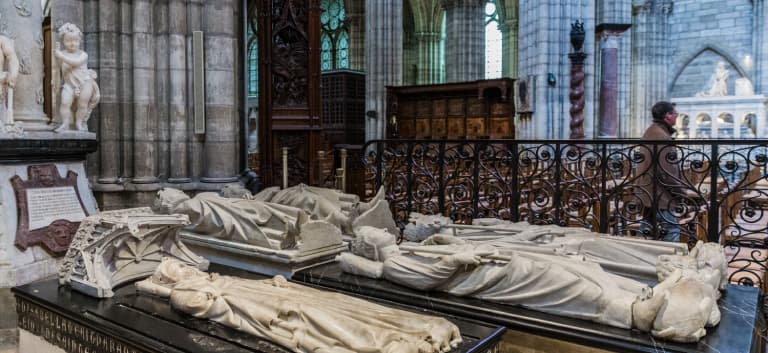
Between 1137 and 1144, the Gothic-style monastery church was built, profoundly influencing and developing this style in France. At the beginning of the 13th century, Louis IX ordered the removal of his predecessors« remains to the basilica and the creation of tombstones for them. From that moment on, the church served as the burial place for the kings of France. The abbey, where almost all the kings of France, as well as members of their families, are buried, is often called »the royal necropolis of France.".
This site is the burial place of 25 kings of France (beginning with Dagobert I, † 638), 10 queens, and 84 princes and princesses. Many of the older tombs were destroyed in October 1793; some were moved to Paris, but were returned there in the following decades.
The Basilica of Saint-Denis during the Revolution
Saint-Denis was looted and closed during the French Revolution, the remains were thrown into the ditch.
After the fall of the constitutional monarchy on August 10, 1792, the interim government decided to melt down the metal objects. To this end, forty-seven tombs in the abbey were dismantled, including the gilded bronze tombstone of Charles VIII, decorated with enamel. Some of these were preserved at the request of the Convention's Fine Arts Commission. In 1793, the Convention initiated the destruction of monuments to feudalism, including noble tombs in all buildings of the republic.
The fate of the royal tombs of Saint-Denis was decided during the Terror, at a meeting of the National Convention on July 31, 1793: «The tombs and mausoleums of the former kings, in particular in the church of Saint-Denis, in churches and other places in the territory of the republic, shall be destroyed before August 10.».
Although the exhumation was delayed, the dismantling took place from August 6 to 10 (51 tombs, statues, tombstones, columns, altars, stained glass windows, etc.). At the request of the Fine Arts Commission, some of the dismantled pieces were preserved and later entered the exhibition of the Museum of French Monuments, established in 1795. The rest was destroyed.
After the destruction of the tombs, the bodies were badly damaged; some were in a state of decay, even reduced to dust (including the corpses of Louis XV and Louis XIV). The body of Henry IV was displayed for several days to passersby in front of the cathedral. More than 170 bodies (46 kings, 32 queens, 63 princes of the blood, 10 dignitaries of the realm, and about two dozen Abbots of Saint-Denis) were then thrown into two mass graves (one for the Valois, the other for the Bourbons) in the monks' cemetery, adjacent to the cathedral.
In 1814, during the restoration, the bones of the kings and members of their family, including Louis XVI and Marie Antoinette, were reburied.
Come and discover the Benedictine abbey of Saint-Denis
Your Private Chauffeur in Enghien-les-Bains will accompany you in this magnificent place to help you discover the beauty, charm and architecture of the Abbey.
Would you like to discover this place? Contact us!